
Best Low-Cost Travel Insurance
Best Travel Insurance for the Lowest Price
Travel insurance is one of the least expensive parts of an international holiday, but it can protect travellers from some of the trip’s largest unexpected expenses.
A suitable policy may cover emergency medical treatment, hospitalisation, medical evacuation, loss of checked baggage, passport loss, trip interruption and specified flight delays. However, benefits, deductibles and exclusions vary substantially between insurers and plans.
The cheapest policy is not automatically the best-value policy. A plan costing a few rupees less per day may provide a much lower medical limit, impose higher deductibles or exclude the activities you plan to undertake.
The best affordable travel insurance is therefore the lowest-priced policy that still provides adequate protection for your destination, health profile and itinerary.
This guide compares current advertised starting prices from major Indian insurers and explains how to avoid buying inadequate coverage merely because it appears cheap.
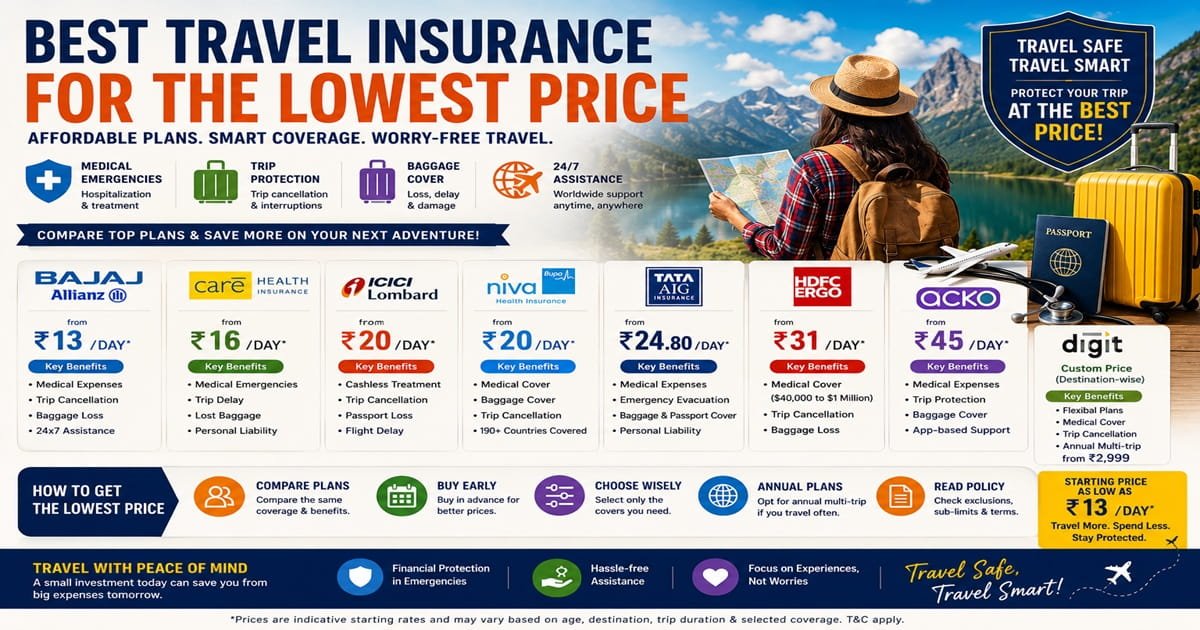
Affordable Travel Insurance Plans at a Glance
| Insurer | Advertised starting price | Key reason to compare |
|---|---|---|
| Bajaj General Insurance | From ₹13 per day | Lowest published headline rate among the options reviewed |
| Care Health Insurance | From ₹16 per day | Very low entry price, but lowest plan carries limited medical cover |
| ICICI Lombard | From ₹20 per day | Low-cost online plan with medical and travel benefits |
| Niva Bupa | From ₹20 per day | Broad international destination coverage |
| Tata AIG | From approximately ₹24.80 per day | Destination-specific plans and multiple cover levels |
| HDFC ERGO | From approximately ₹31 per day | Medical limits ranging from $40,000 to $1 million |
| ACKO | From approximately ₹45 per day | App-first purchase and digital servicing |
| Digit | Destination-specific pricing | Digital process, flexible plans and annual multi-trip option |
These prices cannot be treated as a direct ranking because insurers calculate their examples using different assumptions. Some use a young traveller, long trip duration or very low sum insured to produce the advertised per-day amount.
Why the Cheapest Advertised Rate Can Be Misleading
A headline such as “travel insurance from ₹13 per day” does not necessarily mean your complete trip will be insured at that rate.
The final premium depends on:
-
Traveller’s age
-
Destination
-
Trip duration
-
Medical sum insured
-
Number of travellers
-
Existing medical conditions
-
Deductible
-
Trip-cancellation protection
-
Adventure-sports cover
-
USA and Canada inclusion
-
Single-trip or annual policy
-
Optional add-ons
Longer policies can produce a lower daily rate even when the total premium is higher. Similarly, a plan with only $10,000 of medical cover will normally cost less than a plan providing $100,000 or $500,000.
Care’s lowest advertised international plan, for example, begins around ₹16 per day with a stated cover amount of $10,000. That may be inexpensive, but it should not be compared directly with a policy offering substantially higher medical protection.
1. Bajaj General International Travel Insurance
Best for the Lowest Advertised Starting Price
Bajaj General currently advertises international travel insurance starting from approximately ₹13 per day.
Its international policies can cover specified risks such as:
-
Emergency medical treatment
-
Hospitalisation
-
Medical evacuation
-
Trip cancellation or curtailment
-
Travel delays
-
Checked-baggage loss or delay
-
Passport loss
-
Personal liability
The actual benefits depend on the selected policy and schedule.
Why consider it?
-
Very low advertised entry price
-
Individual, family and senior-traveller options
-
International assistance
-
Medical and non-medical travel protection
-
Single-trip and multi-trip choices
-
Destination-specific products
Check before buying
-
Medical sum insured
-
Deductible for each medical claim
-
Sub-limits for hospital rooms and treatment
-
Whether pre-existing conditions receive any emergency protection
-
Whether adventure activities are included
-
Trip-cancellation limit
-
Baggage compensation limits
Best for
Young, healthy travellers taking a standard holiday who can obtain adequate coverage at a low final quote.
2. Care Explore Travel Insurance
Best for an Extremely Low Entry Premium
Care Health Insurance advertises its Explore international travel plan from approximately ₹16 per day.
The entry-level example provides a stated cover amount of $10,000. Benefits can include trip cancellation and interruption, baggage loss and emergency protection for a pre-existing disease in life-threatening circumstances, subject to policy terms.
Advantages
-
Low published starting price
-
Trip cancellation and interruption benefits
-
Baggage protection
-
Automatic trip extension during eligible medical emergencies
-
Plans for tourists and international students
-
Destination-specific products
Important limitation
A $10,000 medical limit may be inadequate for expensive healthcare destinations or a major hospitalisation.
For comparison, Schengen visa rules require travel medical insurance with at least €30,000 of coverage, valid throughout the Schengen area for the duration of the intended stay. (EUR-Lex)
Best for
Budget travellers visiting lower-cost destinations who select an appropriate medical limit rather than automatically choosing the cheapest plan.
3. ICICI Lombard Travel Insurance
Best Low-Cost All-Round Option
ICICI Lombard advertises travel insurance from approximately ₹20 per day.
Its international travel insurance can include cashless medical support, trip-cancellation cover, baggage protection, passport-loss benefits, flight-delay cover and 24-hour assistance, depending on the selected plan.
Why consider it?
-
Competitive advertised starting price
-
Online application
-
Medical-emergency cover
-
Trip-cancellation and interruption options
-
Lost-baggage and passport protection
-
Products for individuals, families and students
-
Travel-claim support portal
Suitable for
Travellers looking for a balance between a low premium, recognisable insurer and standard medical and journey-related benefits.
Check before buying
Trip cancellation generally applies only when the reason is covered by the policy. It is not a blanket refund for voluntarily changing your plans.
4. Niva Bupa Travel Insurance
Best for Broad Destination Coverage at a Low Entry Price
Niva Bupa currently advertises international travel insurance from approximately ₹20 per day and states that its travel policies cover more than 190 destinations.
Travel insurance can include medical and non-medical protection, depending on the chosen plan.
Potential benefits
-
Emergency medical protection
-
Travel-delay cover
-
Baggage-related protection
-
Passport-loss assistance
-
International travel support
-
Online purchase
-
Region-specific policies
Best for
Travellers seeking a low-cost quote for multiple international destinations.
Check before buying
Review whether hospital treatment is cashless or reimbursement-based in your destination. Cashless service can depend on prior approval and the participating medical provider.
5. Tata AIG Travel Insurance
Best for Destination-Specific Coverage Choices
Tata AIG advertises international travel insurance from approximately ₹24.80 per day, although actual destination-specific rates differ.
For example, its published Indonesia and Singapore pages quote starting prices near ₹25.60 per day. The Singapore plan example includes up to $100,000 of accident and sickness medical cover, along with baggage, passport, personal-liability and evacuation benefits.
Advantages
-
Destination-specific plan information
-
Multiple medical cover levels
-
Emergency medical evacuation
-
Passport-loss cover
-
Baggage delay and loss benefits
-
Personal-liability protection
-
Senior-citizen options
-
Schengen-compatible choices
Best for
Travellers who want to review detailed destination-specific benefit limits before buying.
Important consideration
Tata AIG states that Schengen travel insurance prices can vary widely based on the traveller, cover and plan, illustrating why a single “per-day” headline should not be treated as a guaranteed rate.
6. HDFC ERGO Travel Insurance
Best for Choosing a Higher Medical Limit
HDFC ERGO currently advertises travel insurance from approximately ₹31 per day.
Its international plans offer selectable medical coverage ranging from $40,000 to $1 million. Individual, family, student, senior-citizen and annual multi-trip policies are available.
Potential benefits
-
Emergency medical treatment
-
Cashless hospital network
-
Medical evacuation
-
Trip cancellation
-
Passport loss
-
Baggage loss and delay
-
Missed connections and travel disruptions
-
Coverage choices up to $1 million
Why it may offer better value
A plan with a higher premium can be better value when it provides substantially higher medical coverage than a cheaper entry-level policy.
Best for
-
USA and Canada trips
-
Older travellers
-
Longer journeys
-
Travellers wanting higher medical limits
-
Families requiring one policy
Check carefully
HDFC ERGO’s published information states that standard international travel coverage does not automatically cover pre-existing conditions. Read the specific policy terms rather than assuming an existing illness is protected.
7. ACKO International Travel Insurance
Best for App-First Purchase and Digital Servicing
ACKO advertises international travel insurance from approximately ₹45 per day.
Its current international product page highlights medical protection, trip cancellation and interruption, flight delays, baggage loss, a large cashless-hospital network and customisable coverage.
Advantages
-
Fully digital purchase process
-
App-based account management
-
Cashless medical network
-
Trip-cancellation and interruption benefits
-
Baggage protection
-
Customisable coverage
-
No pre-purchase medical check-up for eligible applicants
Important cancellation rule
Trip-cancellation insurance only pays when the cancellation results from a reason listed in the policy, such as an eligible medical emergency or natural disaster. An airline cancelling its own flight may not be covered under the same benefit.
Best for
Travellers who value digital purchase and claim servicing more than obtaining the absolute lowest headline premium.
8. Digit International Travel Insurance
Best for Flexible Digital Plans and Frequent Travellers
Digit offers international travel insurance covering medical emergencies, baggage issues, passport loss, trip cancellation and personal liability, depending on the plan. It promotes a digital claims process and 24-hour global support.
Unlike insurers displaying one general daily rate, Digit frequently shows destination-specific total prices.
One published example quotes ₹395 for a four-day Malaysia trip for one adult with $50,000 medical coverage. Another product advertises annual multi-trip insurance from ₹2,999, with per-trip duration choices.
Why consider it?
-
Destination-specific quotations
-
Digital purchase and claim process
-
Medical and journey benefits
-
Selected adventure-activity coverage
-
Single-trip and annual multi-trip options
-
Suitable for frequent business travellers
Best for
Travellers who want transparent trip-specific quotations or make several international journeys each year.
Cheapest Does Not Mean Best: What to Compare
1. Medical Sum Insured
Medical protection is usually the most important component of international travel insurance.
Check whether the limit applies to:
-
Hospitalisation
-
Outpatient treatment
-
Emergency room treatment
-
Ambulance
-
Dental emergencies
-
Medical evacuation
-
Repatriation of remains
Do not select a $10,000 plan merely because it is cheapest when travelling to a destination where one emergency admission could exceed that amount.
2. Medical Deductible
A deductible is the amount you must pay before the insurer contributes to an eligible claim.
For example, if the policy has a $100 deductible and the approved medical bill is $500, you may need to bear the first $100.
A cheaper policy with a high deductible may provide less practical value for smaller claims.
3. Cashless Treatment
Cashless treatment means the insurer or its assistance provider coordinates eligible payment directly with the medical facility.
It may still require:
-
Prior approval
-
Immediate contact with the assistance company
-
Use of an approved hospital
-
Medical documents
-
Verification of policy coverage
When cashless treatment is unavailable, the traveller may need to pay first and request reimbursement.
4. Emergency Evacuation and Repatriation
Medical evacuation can be extremely expensive.
Check whether the plan covers:
-
Ambulance transportation
-
Transfer to a better-equipped hospital
-
Emergency return to India
-
Repatriation of remains
These benefits are especially important for remote islands, cruises, mountain regions and adventure trips.
5. Pre-Existing Medical Conditions
Most inexpensive policies exclude ordinary treatment connected with a pre-existing condition.
Some plans may provide limited assistance only when an existing condition creates an immediately life-threatening emergency.
Disclose all requested medical information truthfully. Failure to disclose a known condition can affect claim eligibility.
6. Trip Cancellation
Trip-cancellation cover usually reimburses eligible prepaid and non-refundable costs only when the cancellation is caused by a specified event.
Covered reasons may include:
-
Serious illness
-
Hospitalisation
-
Death in the immediate family
-
Natural disaster
-
Other events specifically listed in the policy
Changing your mind, obtaining a cheaper flight or deciding not to travel is normally not covered.
7. Baggage Protection
Check whether the plan covers:
-
Delay of checked baggage
-
Permanent loss of checked baggage
-
Theft of personal belongings
-
Loss of passport
Baggage claims commonly require documents from the airline, such as a Property Irregularity Report.
Electronics, jewellery and cash may carry lower sub-limits or exclusions.
8. Flight-Delay Benefit
A flight-delay claim normally becomes valid only after the delay exceeds a minimum number of hours.
Check:
-
Required delay period
-
Fixed benefit or reimbursement
-
Eligible causes
-
Maximum payout
-
Documentation required
-
Whether the benefit applies to domestic connecting flights
9. Adventure Sports
Standard budget policies may exclude:
-
Scuba diving
-
Skiing
-
Trekking above a specified altitude
-
Surfing
-
Paragliding
-
Rock climbing
-
Competitive sport
-
Motorcycling without the required licence
Buy an appropriate add-on when your itinerary includes higher-risk activities.
How Much Medical Coverage Should You Buy?
There is no universal amount suitable for every destination.
Schengen Countries
Schengen visa applicants generally require travel medical insurance of at least €30,000, valid across the Schengen territory and for the complete intended stay.
Meeting the visa minimum does not necessarily mean the policy provides ideal protection for every traveller.
United States and Canada
Healthcare can be expensive, so prioritising a higher medical limit and evacuation cover is generally more important than saving a small amount on the premium.
HDFC ERGO, for example, offers selectable limits extending to $1 million.
Southeast Asia
Lower-cost policies may be sufficient for uncomplicated trips, but travellers should still consider their medical history, planned activities, islands or remote areas and the quality of local healthcare access.
Cruises and Remote Trips
Check evacuation, shipboard treatment and cruise-interruption benefits carefully. Standard low-cost plans may not cover every cruise-related disruption.
How to Get the Lowest Travel Insurance Price
Compare Identical Coverage
Obtain quotes using the same:
-
Traveller age
-
Travel dates
-
Destination
-
Medical limit
-
Deductible
-
Cancellation cover
-
Add-ons
Comparing a $10,000 plan with a $100,000 plan does not reveal which insurer offers better value.
Buy Only Relevant Add-Ons
Do not pay for skiing, cruise or adventure cover when the itinerary does not include those activities.
Consider a Family Policy
A family policy can be more economical than buying several individual policies, depending on the travellers’ ages and benefits.
Compare Annual Multi-Trip Insurance
Travellers making several international trips in one year should compare annual cover against separate single-trip policies.
Digit currently advertises annual multi-trip plans from ₹2,999, subject to its trip-duration and eligibility conditions.
Avoid Excessive Medical Cover for Low-Risk Trips
Select adequate protection but avoid buying the highest limit automatically when the destination, trip and traveller profile do not justify it.
Buy Online
Insurers frequently promote lower online starting rates and instant policy issuance through their official websites.
Use a Credit Card’s Insurance Carefully
Some premium credit cards provide travel benefits, but they may cover only tickets purchased with the card or offer limited medical protection.
Read the card policy before deciding that separate insurance is unnecessary.
Common Travel Insurance Exclusions
Exclusions depend on the individual policy, but commonly restricted situations include:
-
Undisclosed pre-existing conditions
-
Planned medical treatment abroad
-
Self-inflicted injuries
-
Alcohol- or drug-related incidents
-
Illegal activity
-
War or specified civil disturbances
-
Unauthorised adventure sports
-
Travelling against medical advice
-
Pregnancy and childbirth outside stated limits
-
Unattended baggage
-
Loss without a police or airline report
-
Cancellation for an uncovered reason
-
Cosmetic or elective treatment
IRDAI explains that an exclusion is a condition, treatment, service or situation that is not covered under an insurance contract. The policy wording and schedule—not the marketing headline—determine whether a claim is payable.
Documents Needed to Buy Travel Insurance
Most online applications request:
-
Full name
-
Date of birth
-
Passport details
-
Travel destination
-
Departure and return dates
-
Indian contact information
-
Nominee details
-
Medical declarations
-
KYC details where required
The issued policy certificate should display:
-
Correct traveller name
-
Passport number where applicable
-
Destination or geographical region
-
Policy dates
-
Sum insured
-
Policy number
-
Emergency contact details
Correct errors before departure.
How to Make a Travel Insurance Claim
Step 1: Contact the Insurer Quickly
For hospitalisation, contact the insurer’s international assistance provider as soon as possible.
Step 2: Follow the Emergency Instructions
The assistance team may direct you to a network hospital or request documents for cashless approval.
Step 3: Collect Evidence
Depending on the claim, retain:
-
Medical reports
-
Prescriptions
-
Hospital invoices
-
Payment receipts
-
Police report
-
Airline delay certificate
-
Property Irregularity Report
-
Baggage receipts
-
Passport replacement documents
-
Flight and hotel confirmations
-
Proof of non-refundable expenses
Step 4: Submit Within the Deadline
Claim-notification and document-submission deadlines vary by insurer.
Step 5: Keep Copies
Store digital copies of every submitted document and communication.
Recommended Shortlist by Traveller Type
Lowest Advertised Starting Rate
Bajaj General Insurance
Its current international product page advertises cover from ₹13 per day. Confirm the sum insured and deductible before choosing it.
Lowest Entry Rate With Basic Benefits
Care Explore
It advertises cover from ₹16 per day, although the lowest example carries only $10,000 of medical protection.
Affordable All-Round Plan
ICICI Lombard
Its advertised ₹20-per-day starting point combines a competitive headline price with medical, baggage and travel-related benefits.
Higher Medical Coverage Options
HDFC ERGO
It offers selectable coverage ranging from $40,000 to $1 million.
App-First Experience
ACKO
Suitable for customers who prefer digital purchase, account servicing and claims assistance.
Destination-Specific Comparison
Tata AIG or Digit
Both publish destination-focused plan information and examples, helping travellers understand benefits before purchasing.
Frequent International Traveller
Digit annual multi-trip plan or another comparable annual policy
Compare the maximum permitted duration of each individual journey before buying.
Frequently Asked Questions
Which travel insurance has the lowest price in India?
Among the official product pages reviewed, Bajaj General currently displays the lowest headline starting price at approximately ₹13 per day. This does not guarantee that it will be cheapest for your age, destination and required medical coverage.
Is ₹13-per-day travel insurance sufficient?
It may be sufficient only when the included sum insured, deductible and benefits match your trip. Review the policy schedule before paying.
Which affordable travel insurance is best for Europe?
Choose a policy valid across all required Schengen countries with at least €30,000 in medical cover, repatriation protection and coverage for the entire stay.
Which travel insurance is best for the USA?
Prioritise high medical coverage, emergency evacuation, low deductibles and cashless support. HDFC ERGO currently provides plan choices extending up to $1 million.
Does cheap travel insurance cover flight cancellation?
Some plans cover trip cancellation for listed reasons. They do not normally reimburse every cancellation or voluntary change of plans.
Does travel insurance cover an airline-cancelled flight?
The airline may owe assistance or a refund under its own rules. Travel-insurance payment depends on the policy wording and cause of cancellation. ACKO, for example, states that its trip-cancellation benefit does not cover an airline cancelling the flight.
Are pre-existing diseases covered?
They are commonly excluded, although some policies offer limited protection during a life-threatening emergency or through an add-on. Full disclosure is essential.
Is travel insurance mandatory?
It depends on the destination and visa. Schengen visa applicants generally require qualifying travel medical insurance with at least €30,000 of cover.
When should travel insurance be purchased?
Purchase it soon after making non-refundable reservations when trip-cancellation protection is important. Coverage begins according to the dates and conditions stated in the policy.
Can travel insurance be purchased after leaving India?
Many Indian policies must be purchased before departure. Confirm eligibility before travelling rather than assuming you can buy it after the trip begins.
Is annual travel insurance cheaper?
It may be cheaper for people taking several international trips within one year. Compare the annual premium, geographical coverage and maximum duration permitted for each trip.
Final Verdict
Bajaj General currently has the lowest advertised starting price among the insurers compared, at approximately ₹13 per day. Care follows at approximately ₹16 per day, while ICICI Lombard and Niva Bupa advertise plans starting near ₹20 per day.
However, these figures should not determine the final purchase by themselves.
Care’s lowest example, for instance, provides only $10,000 of cover, while HDFC ERGO offers choices extending to $1 million. The policies address very different levels of financial risk.
For a short, low-risk trip, compare Bajaj, Care, ICICI Lombard, Niva Bupa and Tata AIG using the same medical limit and deductible. For the United States, Canada, senior travellers or longer journeys, prioritise medical coverage and evacuation benefits over the lowest headline rate.
ACKO and Digit are worth considering when digital servicing is important, while an annual multi-trip policy may save money for frequent travellers.
The best low-cost travel insurance is not the cheapest policy on the screen. It is the least expensive policy that would still provide meaningful help during the emergency you are most likely to face.
Premiums, policy wording, cover limits and eligibility can change. Review the official policy schedule, benefit table, deductibles and exclusions before purchasing. This article provides general information and is not personalised insurance or financial advice.
Most Reviews
Airlines

- September 29, 2026
China Southern Airlines 2026 – Flights, Deals, Baggage & India Routes
Airlines
- September 24, 2026
Air India Exclusive Deals 2026 – Promo Codes and Flight Deals
Airlines

- September 18, 2026
Saudia Holidays Exclusive Offers 2026 – Flight + Hotel Deals
Airlines

- September 16, 2026
Riyadh Air Saudi National Day Sale 2026 – Up to 50% OFF Flights
Hotels

- September 08, 2026
Etihad Holidays 2026: Deals, Packages & Booking
Airlines
- September 02, 2026
Egypt Visa for Indians - Types, Fees and Process
Airlines

- August 25, 2026
Batik Air - Flight Booking, Baggage Allowance, Routes
Hotels

- August 20, 2026
12 Top Hotels Near New Delhi for Every Budget
Airlines

Airlines

- July 22, 2026